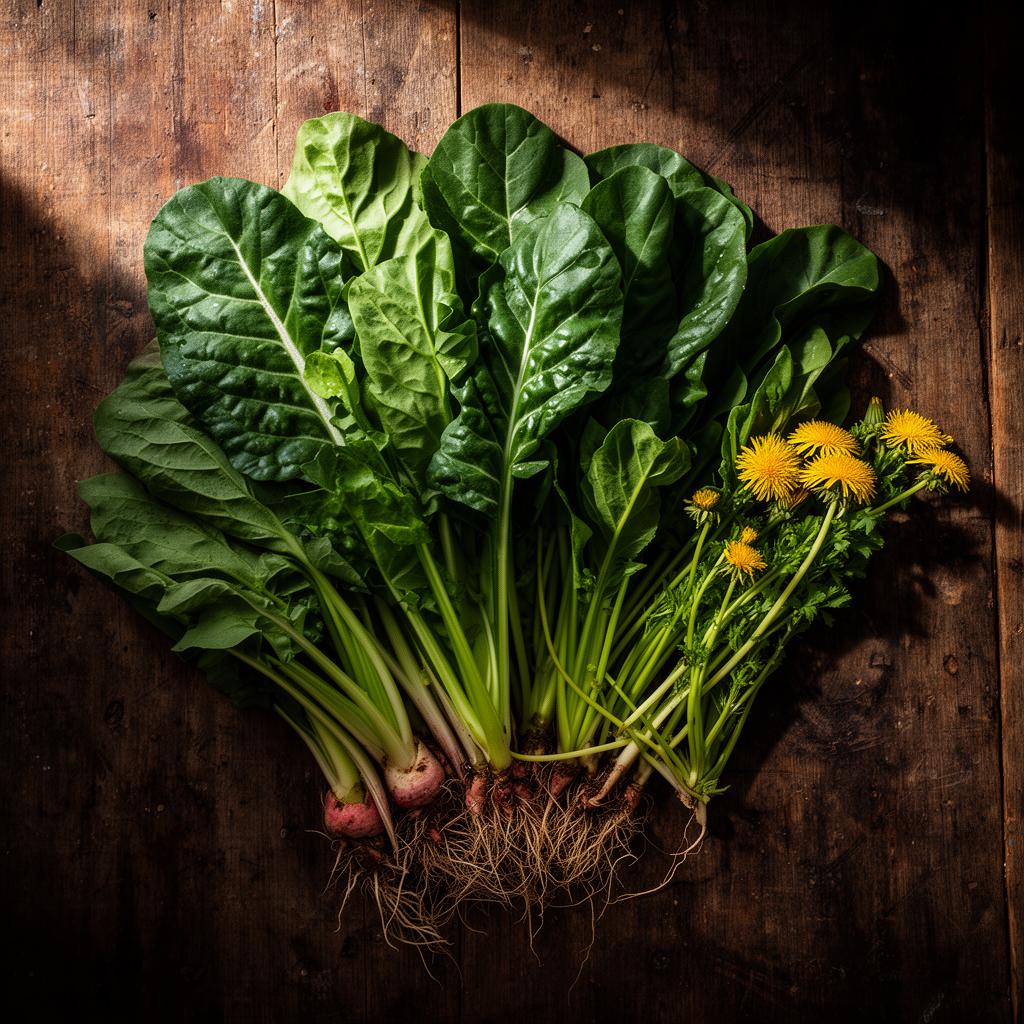
Cooking greens in Black American cuisine is not a simple preparation. It is a distinct technical practice — the long, low braise of a sturdy leaf in a seasoned, smoked liquid until the green surrenders without losing itself. The greens make the pot likker; the pot likker makes the greens. The two chapters belong together because the technique is one technique told from two angles.
What separates a great pot of greens from a mediocre one is almost never the leaf. It is the pot the leaf goes into. The base of rendered smoked fat, the aromatics built before any green enters the liquid, the seasoning held back to be adjusted by taste over the long cook, the heat kept low enough that the leaf gives up rather than toughens — that is the technique. The Field Greens chapter is the architecture; the Pot Likker chapter is the foundation it rises from.
Historical context
The long-braise greens tradition is one of the clearest direct retentions of West African cooking practice in the Black American kitchen. Stewed leaf greens in smoked, fatted, aromatic liquid is the technical signature of cookery from Senegal to the Bight of Biafra. Carried across the Middle Passage, it survived the plantation kitchen because greens were the food enslaved people were largely permitted to keep. It became the cornerstone of the Black Southern table and, in the Lowcountry especially, the most legible African dish in America.
Technical definition
Field-greens cookery is the low, slow braise of a sturdy leaf vegetable in a seasoned, smoked liquid until the leaf is tender, the chlorophyll has softened in color, and the braising medium has taken on flavor from both the seasoning meat and the greens themselves. Mechanically, the long braise breaks down the cellulose and oxalic acid of the leaf, extracts mineral content into the surrounding liquid (creating pot likker), and allows fat-soluble flavor compounds from the smoked seasoning meat to coat the leaf. The technique produces a green that is silken rather than crunchy, a liquid that is the substantive equal of the leaf itself, and a pot whose seasoning is calibrated by the cook over the entire course of the braise rather than at a single moment.
How to execute it
- 01
Build the pot before the greens go in. Render salt pork, bacon, or smoked seasoning meat in a heavy stock pot or enameled Dutch oven over medium heat for ten to fifteen minutes.
- 02
Sweat the aromatics in the rendered fat: a halved yellow onion, two or three smashed garlic cloves, a dried chile or a teaspoon of red pepper flakes, a few grinds of black pepper. Cook five minutes until fragrant.
- 03
Add liquid: water, stock, or last week's pot likker. Cover the seasoning meat. Bring to a low simmer and cook 30 to 45 minutes to build the base liquor before any green enters the pot.
- 04
Season the liquid before the greens go in. Taste it. It should already be a broth you would drink. If it is flat now, the greens will not save it.
- 05
Wash the greens three times in cold water to remove grit. Strip the central rib if it is tough. Cut the leaves into wide ribbons.
- 06
Add greens in batches, stirring each in until it wilts before adding the next. The pot will look impossibly full and then collapse.
- 07
Lower the heat to a bare simmer. Cook covered, tasting and adjusting every fifteen to twenty minutes throughout the braise. Add water as needed to keep the greens at least three-quarters submerged.
- 08
Finish with a splash of pepper vinegar or apple cider vinegar at the very end, off the heat. Acid is a finishing move, never a braising-liquid ingredient.
Ratios, times, temperatures
- Smoked seasoning meat : water ≈ 1 part to 6–8 parts by weight for a rich base.
- Greens : finished liquid ≈ 1 lb cleaned, chopped greens per 3–4 cups of seasoned liquor.
- Aromatics : pot ≈ 1 medium onion, 2–3 garlic cloves, and 1 dried chile per 2 lb of greens.
- Timing by leaf: collards and mustards 1.5–3 hr low; turnip greens 45–60 min; kale and chard 20–30 min; spinach and other quick greens 3–8 min wilting in already-seasoned liquid.
- Finishing vinegar: ≈ 1 teaspoon per quart of finished pot, added off the heat.
Variations
- Mixed pot: collards, mustards, and turnip greens cooked together so each variety contributes a different bitterness, sweetness, and texture to the final pot.
- Pot-likker-on-pot-likker: braising this week's greens in last week's strained pot likker for a deeper, more concentrated base.
- Quick-braised greens: kale or chard wilted twenty minutes in seasoned smoked-paprika broth — the same architecture, scaled to a weeknight.
- Plant-forward braise: smoked olive oil or smoked coconut oil and a strip of kombu in place of seasoning meat; smoked paprika, miso, soy, and a dried mushroom carry the smoke.
- Coconut-milk braise: a diasporic move — finishing the pot with coconut milk after the long braise, more West African than Southern but inside the lineage.
Common failure points
- ✕Adding greens to an unseasoned liquid. The greens never absorb flavor properly because the liquid had nothing to give them. The pot must be a broth before the leaf enters it.
- ✕Cooking at too high a heat. A hard boil toughens the leaf rather than letting it surrender. Low and slow is not a preference; it is the technique.
- ✕Not tasting the pot likker as the greens cook. The liquid and the greens are seasoning each other throughout the entire braise. A pot likker that is right at minute thirty will not be right at minute ninety. Adjust as you go.
Canonical expressions
A pot of collard greens with smoked turkey
The Sunday-dinner standard. Two and a half hours of low braise, the leaf silken, the likker drunk after with cornbread broken in.
Mustard greens with pot likker and pepper vinegar
Sharper than collards, finished bright with the table-side vinegar; one of the canonical Deep South greens preparations.
Turnip greens with their roots diced in
The leaves and the small turnips cooked in the same pot — yield thinking applied to a single plant, the greens silky and the roots peppery and tender.
Mixed field greens
Collards, mustards, and turnips together so each variety contributes differently to a single pot. The deepest expression of the technique.
Quick-wilted kale, apple cider vinegar, red pepper flakes
The faster expression of the same technique: a quick braise in a seasoned liquid with the same finishing acid logic, ready in twenty minutes.
Recipes from Black cooks & writers
- Millie Peartree: Southern Collard Greens (NYT Cooking)
Black chef, canonical method.
- Toni Tipton-Martin: Jubilee greens chapter
The historical method laid out plainly.
- Bryant Terry: Smoky Braised Collards (Vegetable Kingdom)
Plant-based execution of the technique.
What else can this be?
Extensions
Field-greens technique is a long-braise architecture, not a single recipe. Once you can build the pot, you can apply it to cabbage, to bitter greens for a pasta base, to coconut-milk braises, to quick weeknight wilts. The leaf is the variable; the seasoned-liquid foundation is the constant.
- →Braise cabbage as a standalone dish in a pot likker base — same technique, different leaf, a sweet and silken expression.
- →Use bitter greens (dandelion, escarole, chicory) braised in pot likker as a pasta sauce base, finished with pecorino and the braising liquid as the binding sauce.
- →Braise greens in coconut milk after the initial smoked-stock braise — a diasporic expansion that runs the technique back across the Atlantic.
- →Use quick-braised greens as a flatbread or taco filling, finished with hot sauce and pickled red onion.
- →Braise greens with field peas in the same pot so the pot likker becomes a complete one-bowl meal — a working evolution of Hoppin' John logic.
Further reading
- Pot Likker & Braising Liquid as Broth (Techniques chapter 03)
- Jubilee, by Toni Tipton-Martin (Library)
- The Cooking Gene, by Michael W. Twitty (Library)
- Lowcountry & Gullah Geechee (Regions)
- Jubilee, by Toni Tipton-Martin
- The Cooking Gene, by Michael W. Twitty
- Vegetable Kingdom, by Bryant Terry