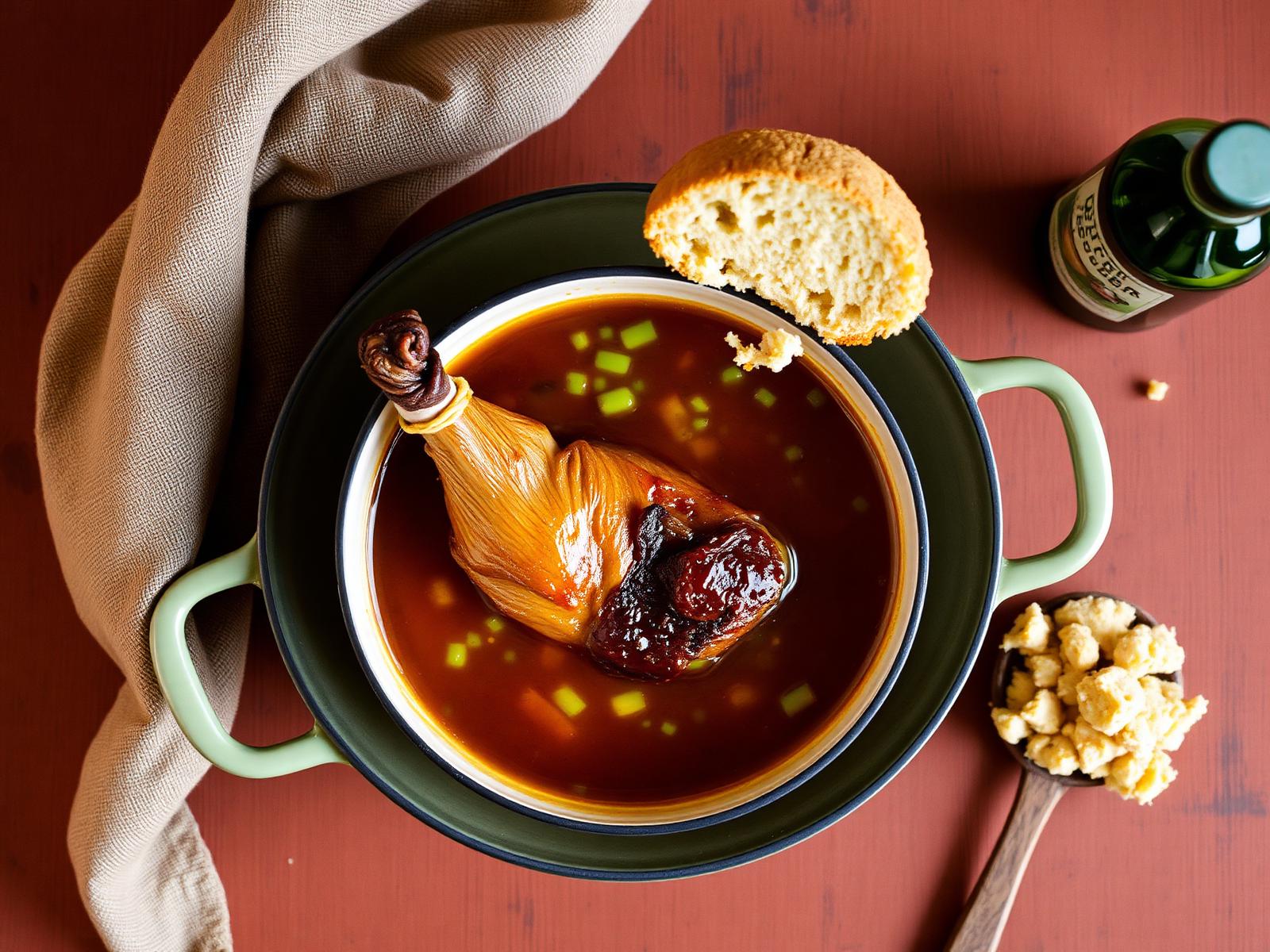
If French cuisine is built on veal stock, Black American cuisine is built on pot likker. The liquid left at the bottom of a pot of long-cooked greens, beans, or field peas, stained deep green or brown, carrying smoke, salt, acid, and hours, is not a byproduct. It is a foundation.
To throw pot likker away is to throw away the point of the dish. We drink it with cornbread crumbled in. We use it to braise the next thing. We treat it the way Escoffier treated demi-glace, as concentrated flavor we built with our own patience.
Note: pot likker is not only from greens. The braising liquid from a pot of field peas, crowder peas, black-eyes, pintos, butter beans, or red beans is equally pot likker. So is the liquid under a pot of slow-cooked cabbage. If it has been seasoned and cooked long, it is pot likker.
Historical context
Pot likker was a survival food on plantations where greens were permitted because they were considered unworthy of white tables. It became a cornerstone because it was both medicine (dense with iron and vitamins) and a vehicle for the smoked seasoning meat that gave it depth. Georgia Gilmore, the Montgomery cook whose Club From Nowhere funded the Montgomery bus boycott, served pot likker as a matter of course.
Technical definition
Pot likker is the seasoned, smoked, slow-simmered braising liquid produced when a pot of greens, dried beans, or field peas is cooked low and long with seasoning meat and aromatics. Mechanically, it is a vegetable-and-meat broth that has been concentrated by evaporation, deepened by the slow extraction of collagen and smoke from the seasoning meat, and stained and seasoned by the substrate it cooked. It produces a stand-alone broth dense enough to drink with cornbread and structured enough to function as a foundation for the next pot, the next sauce, the next pan of rice. In this canon, pot likker is to the Black Southern kitchen what veal demi-glace is to the French one.
How to execute it
- 01
Start with seasoning meat in the pot: smoked turkey wing, smoked ham hock, salt pork, or smoked turkey neck. Cover with water and simmer 45–60 minutes to build the base liquor before the greens or legumes ever go in.
- 02
Add aromatics that will dissolve: a halved onion, a couple of garlic cloves, a dried chile or a teaspoon of red pepper flakes, black pepper. Do not add salt yet, the smoked meat is doing that work.
- 03
Add the substrate: greens (collards, mustards, turnips, or a mix) cut into ribbons, washed three times; OR dried beans soaked overnight; OR field peas fresh or frozen.
- 04
Simmer low and slow. Greens want 45–90 minutes for the leaf to go silky. Dried beans want 1.5–3 hours depending on age and variety. Field peas want 30–45 minutes.
- 05
Finish with acid at the very end: a splash of pepper vinegar or apple cider vinegar, never boiled into the pot. Acid is a finishing move.
- 06
Taste the likker, not just the solids. Adjust salt and vinegar until the broth itself is what you want to drink.
Ratios, times, temperatures
- Seasoning meat : water ≈ 1 part smoked meat to 6–8 parts water by weight for a rich base.
- Greens : liquid ≈ 1 lb cleaned, chopped greens per 3–4 cups of already-simmered likker base.
- Beans / peas : liquid ≈ 1 lb dried beans per 6 cups of likker base; 1 lb fresh field peas per 4 cups.
- Finishing vinegar: about 1 teaspoon per quart of finished likker, enough to brighten, not to sour.
Variations
- Greens pot likker: the classic, collards or mustards over smoked turkey. The deepest, most iron-rich version.
- Bean pot likker: the liquor under red beans and rice, pintos, or a pot of black-eyes. Darker, starchier, sweeter. Best for braising next-day greens or cooking rice in.
- Field pea pot likker: lighter, cleaner, often a little mineral. Excellent reduced into a glaze.
- Cabbage or turnip pot likker: quieter and slightly sweet. Very good with cornbread.
- Vegetarian pot likker: smoked paprika, miso, soy sauce, dried mushrooms, and a strip of kombu can approximate the smoked-meat depth without the meat. Bryant Terry's plant-forward approach lives here.
Common failure points
- ✕Throwing out the liquor. Non-negotiable: you do not drain pot likker.
- ✕Salting too early. The smoked meat is usually all the salt you need; adjust only at the end.
- ✕Boiling off all the liquid. You want the greens submerged or nearly so throughout.
- ✕Boiling the vinegar in. Vinegar added early goes flat and muddy. Add at the end or at the plate.
Canonical expressions
Collards over smoked turkey, with the likker
The full plate: braised collards, a wedge of unsweetened cornbread, and a coffee cup of the green-black likker drunk alongside. The dish that defines pot likker for most cooks.
Red beans and rice
The Monday wash-day dish of Black New Orleans: red beans cooked all day with the trinity, smoked sausage, and pickle meat, the bean likker thickened by mashed beans and ladled over rice.
Field peas with snaps
Fresh purple-hull or crowder peas cooked with trimmed green beans and a smoked turkey wing — a summer Deep South dish where the likker is light, mineral, and almost sweet.
Hoppin' John cooked in pea likker
Lowcountry rice cooked directly in the strained likker from the field peas, then the peas folded back in. The likker is the seasoning of the rice.
Pot-likker greens with cornbread crumbled in
The bowl of likker, alone, with hot cornbread broken into it — the dish that survived enslavement, sharecropping, and the Migration without changing.
Recipes from Black cooks & writers
- Millie Peartree: Southern Collard Greens (NYT Cooking)
Black chef, canonical method.
- Toni Tipton-Martin: Jubilee recipes (excerpt at Food52)
- Bryant Terry: Smoky Braised Collards (Afro-Vegan)
Plant-based pot likker approach.
- BJ Dennis: Gullah red peas & rice (Garden & Gun profile)
What else can this be?
Extensions
Treat pot likker as a mother liquid. Freeze it in labeled quart containers. Build your next stew on it. Reduce it by half for a glaze on roasted sweet potatoes. Mount it with cold butter at the end for a finishing sauce. Cook rice or grits in it instead of water. This is where technique expansion lives.
- →Reduce a quart of greens likker by two-thirds, mount with cold butter at the end, and use as a finishing sauce for roasted sweet potatoes or seared fish.
- →Cook stone-ground grits in pea likker instead of water for a savory grits course under braised short ribs or smoked turkey.
- →Make a Sunday-morning shakshuka-style braise: poach eggs directly in a shallow pan of reduced bean likker with onions and pepper vinegar, served with hot biscuits.
- →Freeze pot likker in labeled pint and quart containers — a working pot-likker library — and pull from it the way a French kitchen pulls from a stock fridge.
- →Use cold strained pot likker as the brining liquid for the next batch of fried chicken; the smoke and salt are already balanced.
Further reading
- Jubilee, by Toni Tipton-Martin (Library)
- The Potlikker Papers, by John T. Edge (Library)
- The Taste of Country Cooking, by Edna Lewis (Library)
- Jubilee, by Toni Tipton-Martin
- The Taste of Country Cooking, by Edna Lewis
- Vegetable Kingdom, by Bryant Terry