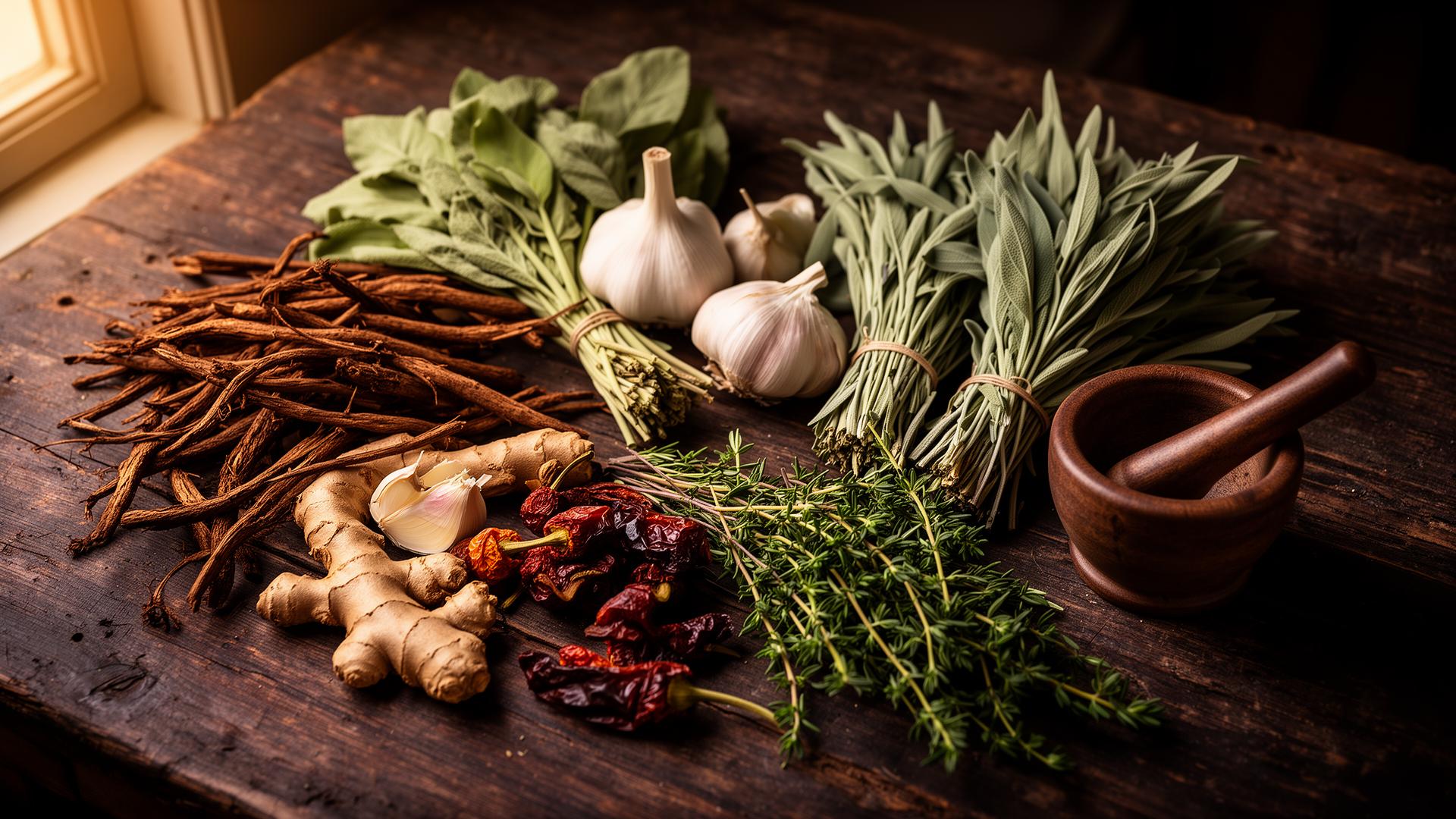
Section 11 · Food As Medicine
The Healing Tradition Underneath The Cuisine
The same hands that seasoned the pot understood which root reduced a fever. That knowledge was never separate from the cooking. It was foundational to it.
Food as medicine is not a trend. It is the oldest truth in Black American cooking. The same hands that seasoned the pot understood which root reduced a fever, which green strengthened the blood, which herb calmed the body after a long day of labor. That knowledge was not separate from the cuisine. It was foundational to it.
This section is built by a chef who came to food through her own healing — informed by plant medicine, indigenous healing traditions, and years of studying what food does to the body at a cellular level. It is written as a culinary reference and a medical one simultaneously, because that is how Black American cooks have always understood food.
Ancestral Plant Knowledge
The herbs, roots, and plants brought from West Africa and Indigenous North America that formed the foundation of Black American healing through food. Each entry follows a three-part format: the ingredient and its origin, its culinary application in this canon, and its documented or traditional medicinal use.
Sassafras
Indigenous North America
In the kitchen. Ground from dried young leaves into filé powder, the off-heat thickener and finishing seasoning of Louisiana gumbo. Brewed as a root tea across the South.
As medicine. Traditionally used as a spring tonic and blood purifier; documented anti-inflammatory and diaphoretic properties.
Elderberry
Indigenous North America (Sambucus canadensis)
In the kitchen. Cooked into syrups, jellies, preserves, and country wines; the cooked berry only — raw berries and stems are not eaten.
As medicine. Documented antiviral and immune-supporting properties; the syrup is the most enduring folk preventative for cold and flu in the Black Southern household.
Dandelion greens
Naturalized across the South, gathered as a field green
In the kitchen. Wilted in pot likker, sautéed in bacon fat, dressed warm with vinegar and a hard-boiled egg.
As medicine. Liver-supporting and gently diuretic; bitter principles stimulate digestion and bile flow.
Yellow dock
Wild bitter green of the rural South
In the kitchen. Cooked the way poke and dandelion are cooked — boiled briefly, then finished in fat with onion and pepper.
As medicine. Iron-rich; traditionally used as a blood-builder for anemia and as a gentle laxative. The Black Southern springtime tonic green.
Collard greens
Brassica brought from the Old World; cultivated and elevated by Black Southern cooks
In the kitchen. Slow-braised with smoked seasoning meat for one and a half to three hours; the central green of Sunday dinner.
As medicine. Exceptional source of calcium, vitamin K, folate, and vitamin A; long braising preserves minerals and concentrates them in the pot likker.
Pot likker
Plantation kitchen and West African one-pot tradition
In the kitchen. Drunk warm with cornbread; reused as a braising liquid; reduced into a finishing sauce.
As medicine. Mineral-dense, bioavailable calcium, iron, and potassium drawn out of the greens by long braise; historically prescribed by Black mothers as a restorative for the sick and the laboring.
Filé powder
Choctaw, taught to French and Black Louisiana cooks
In the kitchen. Stirred into gumbo off the heat at the very end as a thickener and an earthy, root-beer-like finishing note.
As medicine. Traditionally used as a digestive aid; the same sassafras compounds carry mild anti-inflammatory action.
Ginger
South and Southeast Asia, carried into the Caribbean and the American South through the diaspora
In the kitchen. Grated into beverages and brines, candied for confectionery, simmered with sugar for ginger beer and the kitchen tea.
As medicine. Documented anti-inflammatory and anti-nausea action; the standing kitchen remedy for an upset stomach, motion sickness, and morning sickness.
Garlic
Old World allium, ubiquitous in the Black American kitchen
In the kitchen. The base of nearly every savory braise, brine, and sauté in this canon.
As medicine. Documented antimicrobial, antiviral, and cardiovascular benefits; raw cloves in honey are a household tonic for sore throat and the first edge of a cold.
Cayenne pepper
South American Capsicum carried through the Caribbean
In the kitchen. Heat in a fried chicken dredge, in a pot of red beans, in greens, in pepper vinegar.
As medicine. Capsaicin stimulates circulation and acts as a topical and internal pain reliever; the hot toddy with cayenne is a standing remedy for chest cold and sluggish circulation.
Apple cider vinegar
European fermentation tradition adopted into the American household pantry
In the kitchen. Brines, dressings, finishing acid for greens and beans, the base of pepper vinegar.
As medicine. Probiotic acetic acid; traditionally used as a blood-sugar regulator and as the base of fire cider and the morning hot tonic.
Okra
West and Central Africa
In the kitchen. Stewed for body, fried for crust, charred for flavor, pickled for the pantry.
As medicine. Soluble fiber feeds the gut microbiome; emerging research supports anti-inflammatory and blood-sugar–stabilizing properties; the mucilage soothes the digestive tract.
Peanuts
South American legume cultivated and elevated in West Africa, carried back through the Atlantic
In the kitchen. West African peanut soup and stew, boiled peanuts as a Lowcountry roadside snack, peanut brittle, peanut butter, and the cooking-fat traditions of West Africa retained in pockets of the South.
As medicine. Complete protein, healthy fats, and niacin; the foundational subject of George Washington Carver's research at Tuskegee, where his 300+ uses framed the peanut as agricultural medicine for the worn-out cotton soils of the South.
Folk Remedies and the Kitchen Table
These were not superstitions. They were a sophisticated medicinal system developed by people who had limited access to formal healthcare and who used what the land and the kitchen gave them with precision and knowledge passed through generations.
Hot toddy
For: Cold, congestion, sore throatHow it's made. Whiskey or bourbon, hot water, honey, lemon juice, and often a clove or a slice of fresh ginger. Stirred warm in a heavy mug and sipped slowly before bed.
The knowledge underneath. Each ingredient does work: the alcohol opens the chest, the honey coats and antimicrobially calms the throat, the lemon delivers vitamin C, the clove and ginger ease congestion. A sophisticated combination treated, often dismissively, as folk.
Ginger tea
For: Nausea, indigestion, inflammation, the early edge of a coldHow it's made. Two to three slices of fresh ginger steeped in hot water for ten minutes, finished with honey and lemon. Drunk warm.
The knowledge underneath. The standing first remedy in many Black Southern kitchens. Reaches for the same compounds modern anti-nausea drugs are formulated around.
Pot likker as restorative
For: Convalescence, exhaustion after hard labor, mineral depletionHow it's made. A coffee cup of warm pot likker, drunk plain or with a piece of cornbread broken in.
The knowledge underneath. The mineral-dense braising liquid was understood as medicine before nutritional science had the language for it. Rich in bioavailable calcium, iron, and potassium.
Onion poultice
For: Chest congestion, stubborn cough, croup in childrenHow it's made. Sliced or grated cooked onion wrapped in clean cotton cloth, applied warm to the chest under a blanket for thirty to sixty minutes.
The knowledge underneath. Sulfur compounds in onion are absorbed transdermally and through inhalation; an old remedy that quietly resurfaced during the early years of antibiotic resistance.
Garlic in honey
For: Sore throat, immune support, the first sign of illnessHow it's made. Peeled raw garlic cloves submerged in raw honey in a glass jar, allowed to infuse for two to four weeks, then dosed by the spoonful.
The knowledge underneath. Honey is naturally antimicrobial and never spoils; the garlic's allicin diffuses into it. The result is a household antibiotic and immune tonic.
Fire cider
For: Sluggish circulation, the onset of cold or flu, low energyHow it's made. Apple cider vinegar infused with grated horseradish, garlic, onion, fresh ginger, hot pepper, and often turmeric and citrus peel; steeped four weeks, strained, and dosed by the tablespoon.
The knowledge underneath. A folk tonic with deep roots in working-class American herbalism, claimed and reclaimed by Black herbalists who carry the tradition forward.
Elderberry syrup
For: Seasonal immune support, cold and flu prevention, recoveryHow it's made. Dried elderberries simmered with water, cinnamon, clove, and ginger for forty-five minutes; strained and finished with raw honey once cooled. Dosed daily through the cold months.
The knowledge underneath. Documented antiviral activity; the syrup tradition spans Appalachian, Black Southern, and West African herbal lineages.
Mucus and congestion tonic
For: Heavy chest cold, sinus congestion, lingering phlegm, the stubborn tail end of a virusHow it's made. Three cups of apple cider vinegar with the mother, one cup of distilled white vinegar, one teaspoon of salt, a whole sprig of fresh rosemary left on the stem, four tablespoons of cayenne, one tablespoon of turmeric, six whole cloves of garlic from the sleeve (unpeeled, pricked once with a fork), two thinly sliced red onions, and half a white onion. Combine all liquids, spices, and herbs in a heavy pot before turning on the heat — stir cold to dissolve the cayenne and turmeric, then cover. Bring to a medium simmer; at the three-minute mark, add half the sliced onion. At five minutes, cut the heat and stir in the rest of the onion off the burner. Drink a quarter cup of the warm liquid and eat three forkfuls of the onions. Sipped slow while hot. Twice every sixty days as a standing defense; at the first hint of a cold, or deep into one.
The knowledge underneath. A working medicinal in the lineage of fire cider — built around the same logic of acid, heat, allium, and root, scaled up for someone fighting through it rather than maintaining. The vinegar carries the actives, the cayenne moves the blood and breaks the congestion, the garlic and onion do the antimicrobial work, the turmeric and rosemary calm the inflammation underneath.
* Contributed by Chef Arcenjel of Chicago (South Side), May 2026.
This is a form of culinary and medicinal authority that deserves documentation alongside formal nutritional science.
Nutritional Science
What was cooked out of necessity and tradition was also extraordinarily nutrient-dense. That is not a coincidence. Black American cooks selected, prepared, and combined ingredients in ways that maximized nutritional value long before nutritional science existed as a formal discipline.
Collard greens
The numbers. Calcium content comparable to dairy on a per-serving basis. Exceptional vitamin K for bone health. High folate for cellular repair and pregnancy.
Why the preparation matters. Long braising reduces volume but concentrates and preserves the minerals; the pot likker captures what cooks out of the leaf.
Black-eyed peas
The numbers. High in folate, iron, magnesium, and plant protein.
Why the preparation matters. When eaten with rice or corn (Hoppin' John, succotash, peas-and-cornbread) they form a complete amino acid profile. Historically a key ingredient in preventing the nutritional deficiencies that plagued post-Reconstruction sharecropping diets.
Sweet potatoes
The numbers. Beta-carotene (vitamin A), vitamin C, potassium, and four to six grams of fiber per medium tuber.
Why the preparation matters. A near-complete nutritional staple; one of the few foods that can sustain a population over a season. Carver's central crop for Black Southern self-sufficiency.
Okra
The numbers. Soluble and prebiotic fiber that feeds gut microbiota. Vitamin C, vitamin K, folate, and magnesium.
Why the preparation matters. Emerging research supports a role in blood sugar regulation; the mucilage that some cooks try to wash away is exactly the compound doing the medicinal work.
Pot likker
The numbers. Liquid concentration of bioavailable calcium, iron, and potassium drawn out of long-braised greens, plus the gelatin and minerals from smoked seasoning meat.
Why the preparation matters. A drinkable mineral broth; in many rural Black households it functioned as the household electrolyte tonic before that word existed.
Field peas and corn together
The numbers. When combined in the same meal they form a complete amino acid profile, eight of the nine essential amino acids covered without any animal protein.
Why the preparation matters. The succotash logic and the peas-and-cornbread plate are not arbitrary pairings. Black Southern cooks built a complete-protein cuisine without naming it as such.
Cornmeal
The numbers. B vitamins (especially niacin when nixtamalized), iron, magnesium, and complex carbohydrates.
Why the preparation matters. The energy staple of the Black Southern table for two centuries. Stone-ground retains the germ and most of the nutrient density that industrial degermed cornmeal strips out.
Sorghum
The numbers. High iron, antioxidant phenolic compounds, gluten-free complex carbohydrates.
Why the preparation matters. A historic Southern grain crop now resurging; used as syrup, as a whole grain, and as a flour. Carver advocated sorghum as a soil-restoring rotation crop.
Peanuts
The numbers. Complete protein, healthy monounsaturated fats, niacin, folate, magnesium, and resveratrol.
Why the preparation matters. A nutritional staple across the West African and Black American tradition. Carver's research positioned the peanut as a self-sufficiency crop and a near-complete food in itself.
The people who developed this cuisine understood its nutritional power intuitively. The science is simply catching up to what Black cooks have always known.
The Healing Table Today
The ancestral and folk knowledge documented above is not a closed chapter. It is being carried forward by a living network of Black nutritionists, herbalists, farmers, and food sovereignty advocates. Maya Feller's work on culturally rooted nutrition; Karen Washington's organizing through Rise & Root Farm and Black Urban Growers; Leah Penniman's writing in Farming While Black and her organizing through Soul Fire Farm; the Ujamaa Cooperative Farming Alliance; Truelove Seeds; Wendy Johnson and the Black herbalists carrying the apothecary tradition forward.
A personal note from the founder of The Black Food Canon. I came to cooking through my own healing. Plant medicine was the doorway, indigenous healing traditions were the second teacher, and clinical lab science gave me the vocabulary to understand what my grandmother already knew when she put a wedge of lemon in the hot tea and a spoon of honey on top of it. Building this framework is how I keep that knowledge in one place and pass it along honestly.
This layer is open. If you carry a family remedy, a folk preparation, a healing food tradition that belongs in this record, send it to us. The canon expands by being added to.
Read next