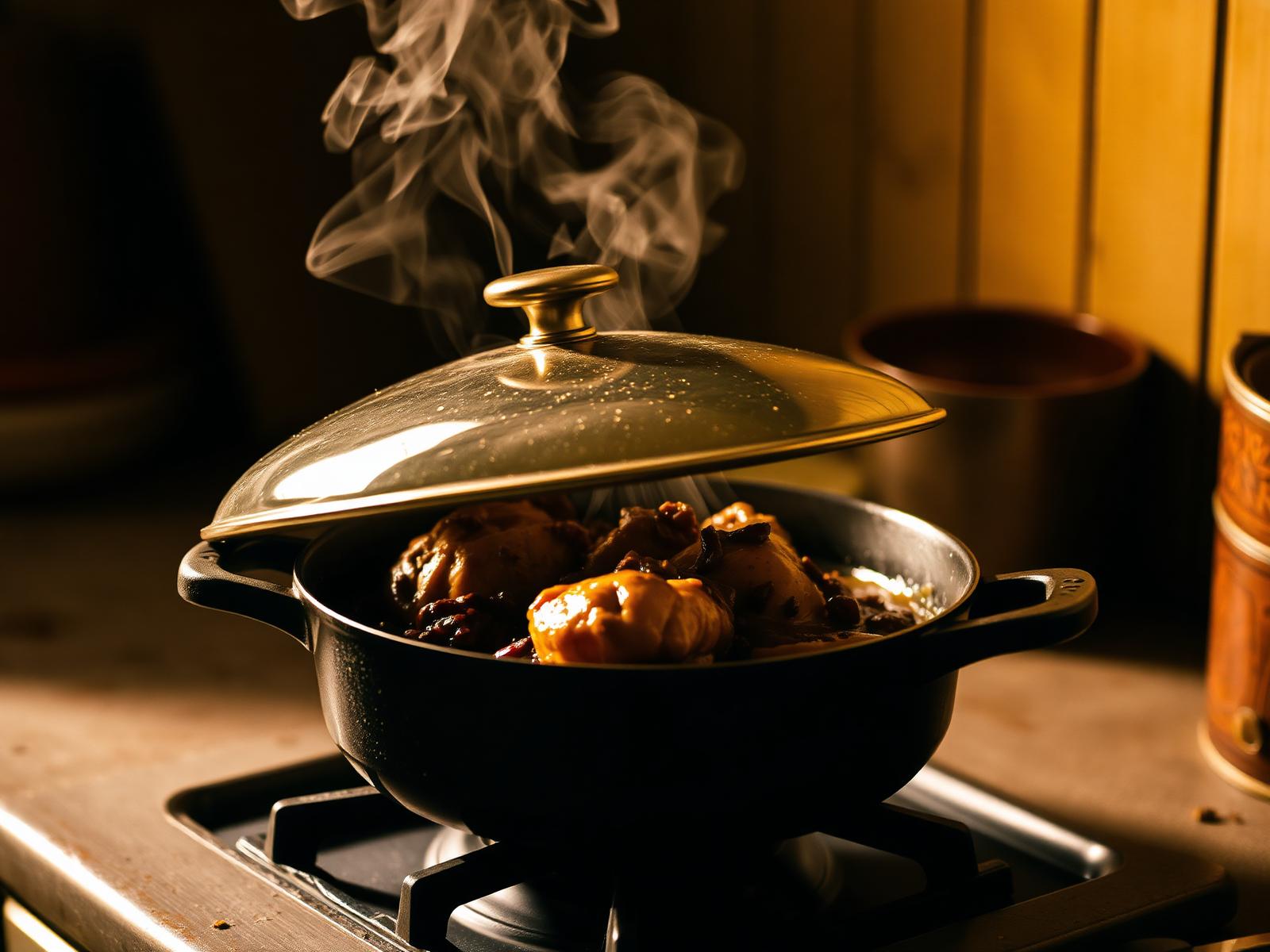
Smothering is what happens when you stop thinking of a sauce as something you add and start thinking of it as something the ingredients themselves become. You layer aromatics in fat, lay the protein on top, close the lid, turn the heat low, and walk away. When you come back, everything is one thing.
Smothered chicken, smothered pork chops, smothered cabbage, smothered okra. This is a technique, not a dish. It is a mode. It is the opposite of searing and plating. It is surrender as a cooking method.
Historical context
Smothering is the clearest descendant of West African one-pot stew cookery, filtered through the cast-iron kitchen of the American South. It is the technique that makes a tough cut tender, an aging vegetable sweet, a little bit of meat feed a whole table.
Technical definition
Smothering is a covered, low-heat braise in which a heavy bed of sliced onion (and often celery and bell pepper) is sweated to silkiness in fat, lightly thickened with the dredging flour from the protein, deglazed into a loose gravy, and used to finish-cook a dredged-and-browned protein under a tight lid. Mechanically, the closed pot creates a low-pressure steam environment that converts collagen to gelatin in tough cuts while the onions break down into a sauce-body the dish never had to add separately. The result is a one-pan dish where the gravy, the aromatics, and the protein finish as a single integrated thing rather than a protein with a sauce on top.
How to execute it
- 01
Dredge the protein in seasoned flour (salt, black pepper, cayenne, garlic powder, onion powder, paprika). Shake off the excess.
- 02
Brown the protein in fat, bacon grease, lard, or neutral oil, in a heavy lidded skillet. You are building fond on the bottom of the pan; that is the sauce base.
- 03
Remove the protein. Sweat a heavy pile of sliced onion (plus celery and bell pepper if Louisiana-leaning) in the same fat until silky and starting to caramelize at the edges.
- 04
Sprinkle a tablespoon or two of the remaining dredging flour over the onions and stir. You are making a miniature roux in place.
- 05
Add stock or pot likker or water to deglaze, scraping up the fond. You want a loose gravy, about the thickness of heavy cream.
- 06
Return the protein, spoon gravy over it, cover, and drop to low. Cook 45 minutes (chicken thighs) to 90 minutes (pork chops or tough cuts) until a fork slides through.
- 07
Finish with a splash of vinegar or hot sauce at the plate, not in the pot.
Ratios, times, temperatures
- Flour in the dredge: 1 cup flour per 2 teaspoons salt, 2 teaspoons seasoning blend, 1 teaspoon cayenne (adjust to taste).
- Onion : protein ≈ 1 large yellow onion per pound of meat. Double that for a classic Louisiana version.
- Gravy consistency: starts loose, reduces to the back of a spoon. If it tightens too much, loosen with stock, never water.
Variations
- Smothered chicken: bone-in thighs and legs are the canonical cut.
- Smothered pork chops: center-cut, 3/4-inch thick, not boneless.
- Smothered cabbage: wedges nestled in bacon fat and onion; cook until the cabbage surrenders its water and returns it as sauce.
- Smothered okra and tomatoes: a late-summer version where the tomato does the acid work.
- Smothered mushrooms, cauliflower, winter squash: the technique is indifferent to the substrate.
Common failure points
- ✕Not enough onion. Smothering is an onion technique first, a protein technique second.
- ✕Heat too high under the lid. The liquid should be at a bare simmer, trembling, not bubbling.
- ✕Skimping on the dredge. The flour on the protein is doing thickening work for the whole pot.
Canonical expressions
Smothered chicken (bone-in thighs and legs)
The canonical Sunday smother: dredged in seasoned flour, browned in bacon fat, finished under a heavy lid in onion gravy until the meat falls from the bone.
Smothered pork chops (bone-in, center cut)
Three-quarter-inch chops dredged, browned, and braised in onion gravy for ninety minutes. The cut that punishes high heat and rewards smothering.
Smothered cabbage
Wedges or coarse slices nestled in bacon fat and yellow onion under a tight lid until the cabbage releases its water and reabsorbs it as a sweet, glossy sauce.
Smothered okra and tomatoes
The late-summer Deep South smother where the tomato is the acid and the okra is the thickener; no flour required.
Smothered oxtails
The Sunday-upgrade smother: long-braised oxtails in onion-and-trinity gravy until the meat slides off the bone and the gelatin makes the gravy lacquer the rice.
Recipes from Black cooks & writers
- Toya Boudy: Smothered Chicken (Cooking for the Culture)
- The Grey (Mashama Bailey), smothered vegetables approach
- Rosie Mayes: Smothered Pork Chops (I Heart Recipes)
What else can this be?
Extensions
Smothering extends anywhere a tough or humble ingredient wants time. Smother mushrooms. Smother winter squash. Smother a whole head of cauliflower. The technique doesn't care what's in the pot.
- →Smother a whole head of cauliflower in trinity gravy with a peanut-butter-stage roux underneath — a technique-faithful vegetarian centerpiece that earns its place on the table.
- →Smother king oyster mushrooms cut into thick coins; the texture conversion approaches the bite of a smothered chicken thigh while the gravy stays meatless.
- →Smother butternut squash steaks with a bacon-fat onion base and a finish of pepper vinegar — a fall version that proves the technique is indifferent to the substrate.
- →Smother lamb necks in a dark-roux base instead of an in-pan flour roux, building a hybrid between gumbo and smothering for a winter Sunday plate.
- →Smother whole leeks slowly in brown butter and pot likker for a side dish that translates the technique into a finer-dining register without losing the lineage.
Further reading
- Mosquito Supper Club, by Melissa M. Martin (Library)
- Black Food, edited by Bryant Terry (Library)
- A Real Southern Cook, by Dora Charles (Library)
- Mosquito Supper Club, by Melissa M. Martin
- Black Food, by Bryant Terry (ed.)