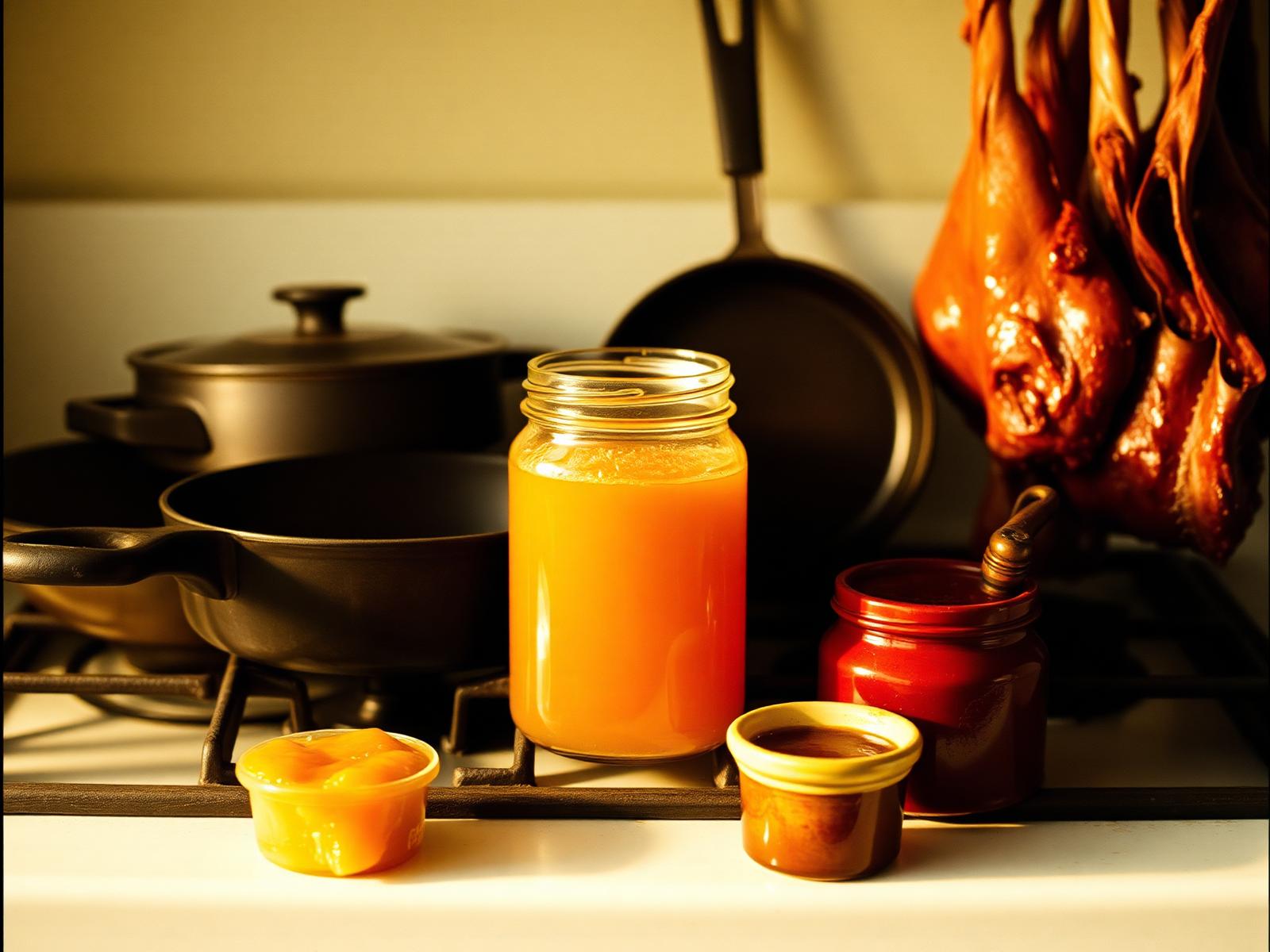
Lard. Bacon grease. Smoked turkey drippings. Neck-bone fat. Oxtail fat. In this tradition, rendered fat, especially smoked rendered fat, is not a cooking medium. It is an ingredient. It carries the smoke, the salt, and the memory of the animal.
The jar of bacon grease on the back of the stove is a piece of inherited technology. It is seasoning, finishing, and starting medium. It is also why a pot of greens cooked in water and seasoned with a smoked turkey wing tastes the way it does.
Historical context
This is a direct inheritance from West African palm-oil cookery and the plantation kitchen's making-do with what pork produced. It is one of the most recognizable flavor signatures of the cuisine.
Technical definition
In this canon, rendered fat — especially smoked rendered fat — is treated as an ingredient with its own flavor identity rather than as a neutral cooking medium. Mechanically, rendering slowly liquefies adipose tissue and (when the source is smoked) carries its phenolic smoke compounds, residual salt, and Maillard byproducts into a clarified fat that can then be reapplied to other foods at much lower volumes than the original meat would require. A spoonful of bacon grease in a pot of greens delivers more pork flavor than the actual pork in the pot. The technique is what makes a one-ham-hock pot of greens taste like the whole hog visited it.
How to execute it
- 01
Render slowly: diced pork fat (or cut-up smoked meat) in a heavy pot with a quarter cup of water, on low, until the water cooks off and the fat melts clear. Strain while warm.
- 02
Store: clean glass jar in the fridge, labeled with source and date. It will keep 3 months refrigerated, 1 year frozen.
- 03
Cook with it: grease the skillet for cornbread; start the onion for greens in it; fry chicken in seasoned lard; finish rice by stirring in a spoonful at the end.
- 04
Smoke fats directly: duck fat cold-smoked over hickory, beef tallow over pecan, ham hock fat rendered after a long smoke.
Ratios, times, temperatures
- Cornbread skillet: 2 tablespoons fat preheated in a 10-inch cast iron until it smokes lightly, then the batter hits.
- Rice finish: 1 teaspoon rendered smoked fat per cup of cooked rice, stirred in off heat.
- Greens: 2–3 tablespoons of bacon or smoked-turkey drippings per pound of greens (in addition to the seasoning meat in the pot).
Variations
- Build a fat library: labeled jars of bacon, duck, ham hock, beef tallow, smoked turkey. Choose by dish.
- Brown butter / beurre noisette in the Southern pantry: an under-used finishing move for greens and biscuits.
- Plant-forward parallel: smoked olive oil, smoked coconut oil, and roasted-peanut oil carry similar work without animal fat.
Common failure points
- ✕Letting the jar of grease go rancid. Smell it. If it's off, dump it.
- ✕Rendering too hot. You want slow clarifying, not deep-frying the meat in its own fat.
Canonical expressions
Cornbread baked in a smoking-hot bacon-fat skillet
The pre-greased cast iron is the vehicle for the fat; the crust that forms in those first thirty seconds is the entire reason for the technique.
Collards with smoked turkey drippings
A pot of greens whose seasoning meat has been smoked first; the fat that renders into the likker is the dominant flavor of the dish.
Rice finished with smoked ham-hock fat
Carolina-style rice cooked in water, then off-heat stirred with a teaspoon of strained smoked fat per cup — the closing move that ties the rice to the rest of the plate.
Fried chicken in seasoned lard or peanut oil
The cooking fat is the secondary seasoning of the chicken; reused, strained lard from previous fries carries flavor forward across weeks.
Hot-water cornbread fried in bacon grease
The simplest, oldest cornbread cooked in the seasoned fat that has been on the back of the stove for months — the dish where the pan and the fat are most of the recipe.
Recipes from Black cooks & writers
- Jocelyn Delk Adams: Cast-Iron Cornbread (Grandbaby Cakes)
- Edouardo Jordan: Whole animal butchery and fat rendering
What else can this be?
Extensions
Build a fat library. Smoked duck fat. Smoked beef tallow. Rendered ham hock fat. Label and date them. Use them the way a Japanese cook uses dashi, as a foundation you choose from.
- →Build a labeled fat library: bacon, smoked-turkey, duck, ham-hock, beef tallow, smoked olive oil. Choose by dish the way a Japanese cook chooses a dashi base.
- →Cold-smoke beef tallow over post oak for two hours and use it to fry a Sunday potato hash — the smoke is in the fat, not the meat.
- →Make a smoked-fat compound butter (one part rendered smoked turkey fat to four parts cultured butter); finish biscuits, grits, and cornbread with it.
- →Build a plant-forward parallel: cold-smoke virgin coconut oil and roasted-peanut oil, store labeled, and use them in vegan greens and beans where the smoke needs to lead and the meat is intentionally absent.
- →Render and clarify the fat from a smoked Thanksgiving turkey carcass; use it as the cooking fat for the next month's cornbread skillets — Thanksgiving carrying its flavor into Christmas and beyond.
Further reading
- High on the Hog, by Jessica B. Harris (Library)
- The Cooking Gene, by Michael W. Twitty (Library)
- Black Smoke, by Adrian Miller (Library)
- High on the Hog, by Jessica B. Harris
- The Cooking Gene, by Michael W. Twitty