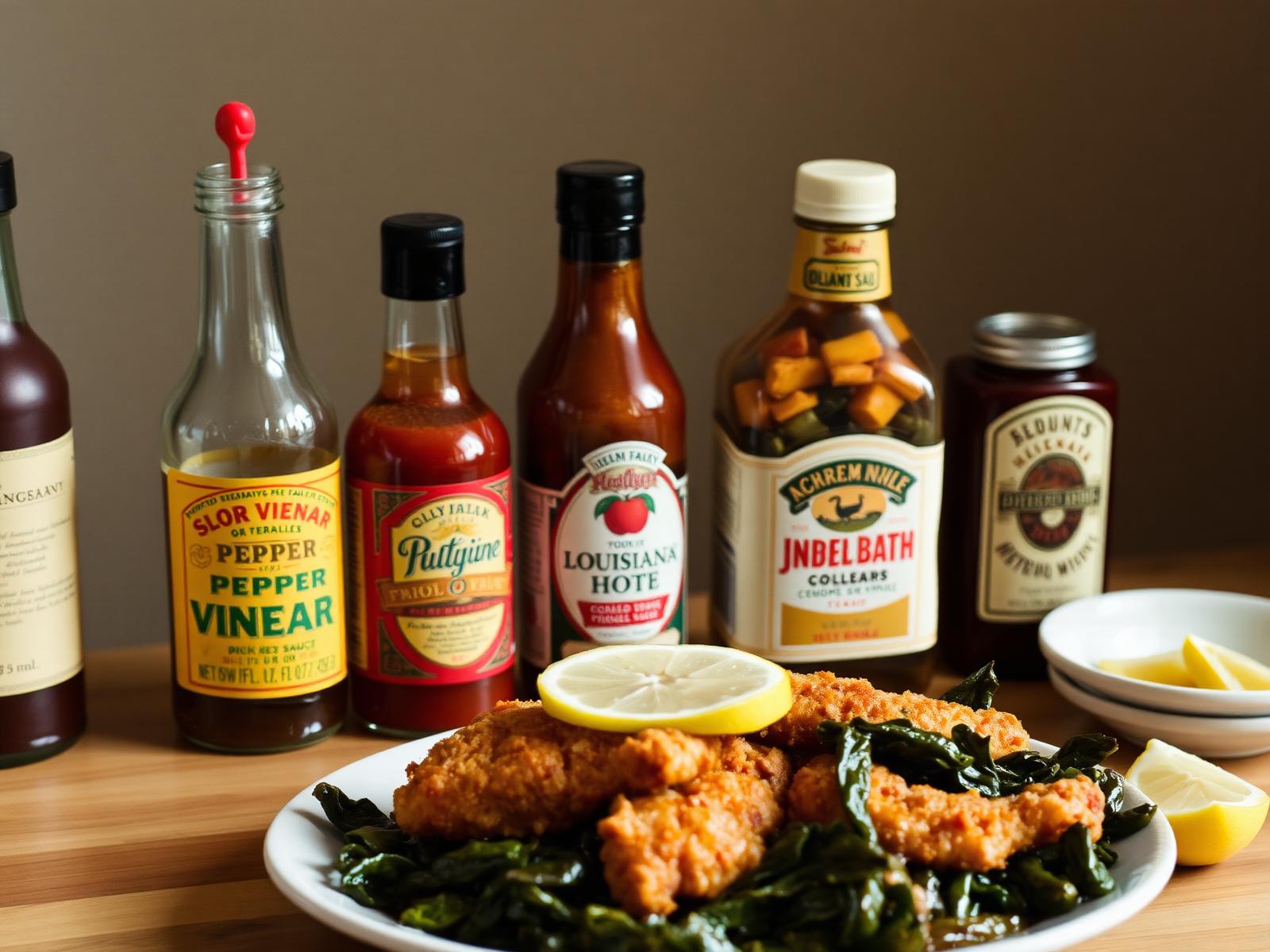
Pepper vinegar on greens. Hot sauce on everything. A squeeze of lemon on catfish. Pickled onions on a plate of beans. In Black American cooking, acid and heat work as a paired system. They cut richness, brighten depth, and wake up a long-braised dish.
This is not garnish logic. It is finishing logic. The dish is not done until the vinegar and the chile have had their say.
Historical context
The pairing traces directly to Caribbean and West African practice. It is also why a bottle of hot sauce is closer to a tool than a condiment in any kitchen that takes the tradition seriously.
Technical definition
Acid and heat function in this canon as a paired finishing system applied at the plate, not the pot. Mechanically, acid (acetic, citric, lactic) cuts perceived fat by stimulating saliva and shifting the palate's read of richness; capsaicin from chiles activates a parallel sensory channel that amplifies the perception of both acid and salt. Together they brighten and lengthen the finish of a long-cooked dish without changing its base flavor. The technique produces a complete plate from a heavy one: pot-likker greens with pepper vinegar at the table, fried fish with hot sauce, red beans with chow-chow on the rim. The dish is not done until acid and heat have had their say.
How to execute it
- 01
Build acids: a house pepper vinegar, a house hot sauce, a jar of chow-chow, a bottle of apple cider vinegar, a lemon on the cutting board. Every plate has access to at least two.
- 02
Finish at the plate, not in the pot: a teaspoon of pepper vinegar over collards as they hit the bowl; a shake of hot sauce on fried fish; pickled onion across red beans.
- 03
Pair by richness: the heavier the dish, the brighter the acid should be. Pot likker greens want vinegar; a fried snapper wants lemon; red beans want chow-chow.
Ratios, times, temperatures
- Finishing acid: about 1 teaspoon liquid acid per 1-cup serving, enough to perk, not to pucker.
- House hot sauce: aim for pH ≤ 4.2 for shelf stability (measure if bottling). Fresh-use sauces don't need this.
Variations
- Three-acid board: pepper vinegar, cider vinegar, fresh citrus. Three-heat board: a vinegar hot sauce, a fermented hot sauce, and chow-chow.
- Regional heat: Scotch bonnet (Caribbean), cayenne (Louisiana), Carolina reapers in the modern Carolinas, datil in St. Augustine.
Common failure points
- ✕Cooking the acid in. Vinegar boiled for hours turns flat. Add it at the end.
- ✕Treating hot sauce as a dare. Heat is a flavor, not a challenge. Build it to season, not to overwhelm.
Canonical expressions
Collards with pepper vinegar at the table
The dish where the technique is most legible: the smoked-meat-and-greens depth on the plate, the pepper vinegar applied by the eater, one teaspoon per bowl.
Fried catfish with hot sauce and lemon
Two acid-heat finishers — vinegar-based hot sauce and fresh lemon — applied at the plate to a fish whose flavor came from the cornmeal and the oil.
Red beans with chow-chow
A spoonful of pickled cabbage relish on top of a bowl of slow-cooked red beans — the sweet-sour-hot counterpoint to the slow round depth of the bean likker.
Smothered pork chop with a lemon wedge
The Upper South finishing move: a squeeze of lemon over the brown gravy, lifting the dish out of richness without thinning it.
Fried green tomatoes with pepper jelly
Sweet, hot, and acidic on top of a fried, fatty base — the flavor logic of the canon condensed onto a single bite.
Recipes from Black cooks & writers
- Nicole A. Taylor: Quick Pickles & Hot Sauces
- Bryant Terry: Acid-forward plant cooking
What else can this be?
Extensions
Build finishing acids and heats as their own course of the meal. A board of three vinegars and three hot sauces tells as much of the story as the main dish does.
- →Build a three-vinegar / three-heat board for the table: pepper vinegar, apple cider vinegar, and a fermented hot sauce; chow-chow, pickled okra, and a fresh chile relish. Treat it as part of the meal, not as condiments.
- →Make a regional-chile flight of three hot sauces — Scotch bonnet (Caribbean), cayenne (Louisiana), datil (St. Augustine) — to teach the difference between heat varieties at one sitting.
- →Finish a roasted whole sweet potato with brown butter, smoked salt, and a teaspoon of pepper vinegar; the acid keeps the dish from collapsing into pure sweetness.
- →Build a yearly preserved-citrus practice (preserved lemons, preserved Meyer lemons, preserved limes); use the brine as a finishing acid on greens and the rind as a chop-up for rice.
- →Develop a house finishing-acid for braises: equal parts apple cider vinegar, hot sauce brine, and pot likker, kept in a squeeze bottle on the line and applied at plate-up the way a French line cook applies butter.
Further reading
- Jubilee, by Toni Tipton-Martin (Library)
- Watermelon & Red Birds, by Nicole A. Taylor (Library)
- Jubilee, by Toni Tipton-Martin