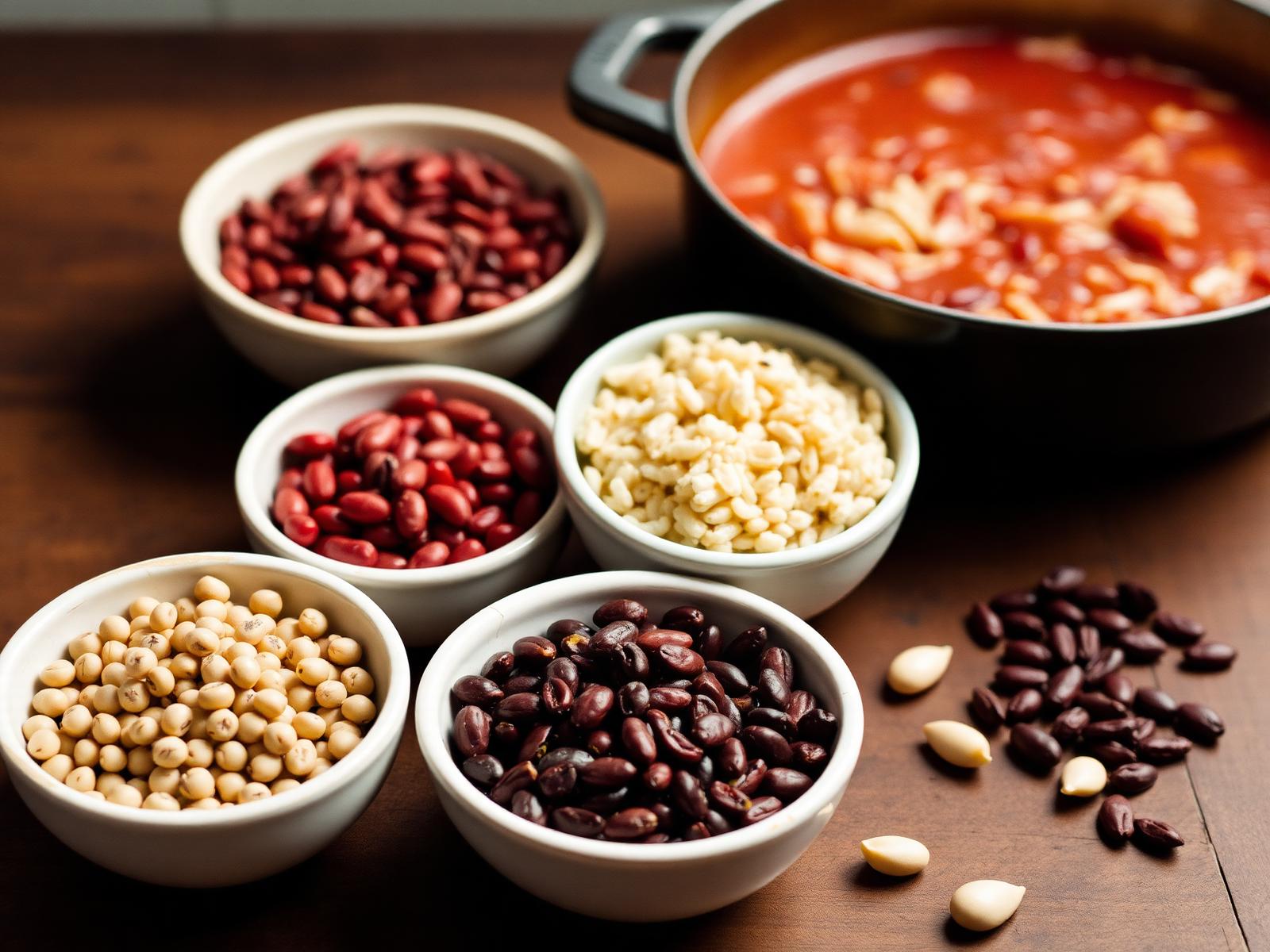
Red beans on Monday. Black-eyed peas on New Year's. Field peas with snaps in July. Butter beans slow-cooked Sunday. Legumes are the protein backbone of Black American cooking, cheaper than meat, deeper in flavor the longer they cook, and carrying the smoked seasoning meat and pot likker forward in every serving.
Treat legumes as the star, not the filler. The bean is not a supporting role. It is the plate.
Historical context
Black-eyed peas came across the Atlantic on slave ships from West Africa, where they had been cultivated for thousands of years. Field peas (crowder, purple hull, lady peas, pink-eyes) are their American descendants. Red beans and rice is the Monday wash-day dish of Black New Orleans, slow-cooked on the stove while the week's laundry got done. Every region has its bean, and every bean has its day.
Technical definition
The legume technique of this canon is the slow, low-temperature simmer of dried beans, field peas, or black-eyed peas with seasoning meat and aromatics until the beans are creamy through but intact, the cooking liquid has reduced to a silky, slightly thickened pot likker, and the dish is ready to feed two to three subsequent meals. Mechanically: salt-soaking pre-seasons the bean and softens the seed coat so the interior cooks evenly; a bare simmer (never a hard boil) prevents skin rupture; mashing a portion of the cooked beans back into the liquid releases starch as a natural thickener; the seasoning meat slowly contributes collagen, smoke, and salt across the cook. The bean is the protein, the carbohydrate, and the broth in one pot.
How to execute it
- 01
Sort and rinse: spread dried beans on a sheet pan and pick out stones and broken beans. Rinse.
- 02
Soak: cover with cold water by 3 inches, add 1 tablespoon salt per pound, soak 8–12 hours (or use the quick soak: boil 2 minutes, cover, rest 1 hour). Salt in the soak seasons and tenderizes; it does not prevent softening despite the old myth.
- 03
Cook: drain the soak water. Cover beans by 2 inches with fresh water or stock. Add a smoked ham hock, smoked turkey wing, or salt pork. Add a halved onion, a couple of garlic cloves, a bay leaf, and black pepper.
- 04
Simmer low and slow: never a hard boil (that breaks the skins). 1.5 to 3 hours depending on variety and age. Old beans can take twice as long as the bag suggests.
- 05
Finish: once tender, mash about a cup of beans against the side of the pot and stir back in. That's the natural thickener for the pot likker. Taste, adjust salt, add a splash of pepper vinegar or hot sauce.
- 06
Serve: over rice, with cornbread, with collards on the side. Save the pot likker for tomorrow's greens or rice.
Ratios, times, temperatures
- Beans : liquid ≈ 1 lb dried beans to 6 cups water or stock.
- Salt in the soak: 1 tablespoon Diamond Crystal kosher (or 1.5 tsp fine sea salt) per lb, per quart of soak water.
- Seasoning meat: 1 smoked ham hock or 2 smoked turkey wings per lb of beans.
- Cooking time by variety: black-eyed peas 1–1.5 hr; pintos 1.5–2 hr; red kidney / red beans 2–2.5 hr; butter beans 1.5–2 hr; crowder / field peas 45 min–1.5 hr fresh, 1–1.5 hr dried.
Variations
- Red beans and rice (New Orleans Monday): camellia-brand red beans, andouille or pickle meat, the holy trinity, cooked all day, served over rice.
- Hoppin' John (Lowcountry New Year's): field peas and rice in one pot, with smoked meat and pot likker.
- Limpin' Susan: okra and rice cousin to Hoppin' John.
- Butter beans with ham hock (Upper South Sunday): slow-cooked large limas until creamy.
- Black-eyed peas with collards and cornbread (New Year's Day canon): the full trinity plate, peas for coins, greens for paper money, cornbread for gold.
- Peas and snaps (summer Deep South): fresh field peas cooked with trimmed green beans in the same pot.
- Senate bean soup / ham & bean: Northern migration bean cooking.
Common failure points
- ✕No soak on old beans. Beans over a year old need a full soak or they will stay chalky no matter how long you cook them.
- ✕Hard boil. Breaks skins, turns beans to mush on the outside and chalky inside.
- ✕Skipping the mash. Mashing a cup of beans back in is how you get that silky, almost creamy likker without cream.
- ✕Underseasoning. A pound of beans can take 2–3 teaspoons of salt by the end. Taste in stages.
- ✕Throwing out the pot likker. This is pot likker. Save it, freeze it, cook rice in it.
Canonical expressions
Red beans and rice (New Orleans Monday)
Camellia-brand red beans cooked all day with the trinity, andouille or pickle meat, and pork seasoning, served over Carolina-style rice. The Black New Orleans wash-day dish.
Black-eyed peas with collards and cornbread (New Year's Day)
The full trinity plate: peas for coins, greens for paper money, cornbread for gold. The Lowcountry-rooted Black American holiday meal.
Hoppin' John
Field peas and rice in one pot with smoked meat and pea likker. The Lowcountry New Year's grain-and-legume dish.
Butter beans with ham hock (Upper South Sunday)
Slow-cooked large limas in smoked-pork stock until the beans go creamy and the likker is sweet, served with cornbread or biscuits.
Field peas and snaps (Deep South summer)
Fresh purple-hull or crowder peas cooked with trimmed green beans and a smoked turkey wing — the late-July one-pot from the garden.
Limpin' Susan
Hoppin' John's cousin: okra and rice cooked together in one pot, often with bacon. The Lowcountry's other one-pot legume-grain dish.
Recipes from Black cooks & writers
- Toya Boudy: Red Beans and Rice (Cooking for the Culture)
- Millie Peartree: Black-Eyed Peas (NYT Cooking)
Black chef, canonical method.
- BJ Dennis: Hoppin' John (Garden & Gun profile)
- Matthew Raiford: Field peas in Bress 'n' Nyam
- Bryant Terry: Smoky Black-Eyed Peas (Afro-Vegan)
What else can this be?
Extensions
The bean is also a technique for next-day cooking. Day one: beans and rice. Day two: the pot likker becomes the braising liquid for collards. Day three: the last beans mashed, spread on cornbread, topped with pickled onion. One pound of beans should feed a kitchen for three days and teach three different lessons.
- →Cook a pot of black-eyed peas in pot likker reserved from the previous week's collards — the dish builds depth from the kitchen's own past.
- →Smoke dry beans (yes, dry) cold over hickory for two hours before soaking and cooking; the smoke is in the seed, not just the seasoning meat.
- →Build a New Year's plate that swaps the smoked turkey wing for a koji-cured pork shoulder — the same seasoning-meat role played by a fermented modern cure.
- →Reduce a quart of bean likker to a syrup, mount with cold butter, and use it as a glaze for roasted root vegetables: the bean carrying its work into a course where it does not appear.
- →Make a Sunday tasting menu of three field peas (lady, crowder, purple-hull) cooked the same way side by side, to teach the eater that field pea is a category, not a single ingredient.
Further reading
- Jubilee, by Toni Tipton-Martin (Library)
- Bress 'n' Nyam, by Matthew Raiford (Library)
- The Taste of Country Cooking, by Edna Lewis (Library)
- Jubilee, by Toni Tipton-Martin
- Bress 'n' Nyam, by Matthew Raiford
- Camellia Beans, by New Orleans heritage