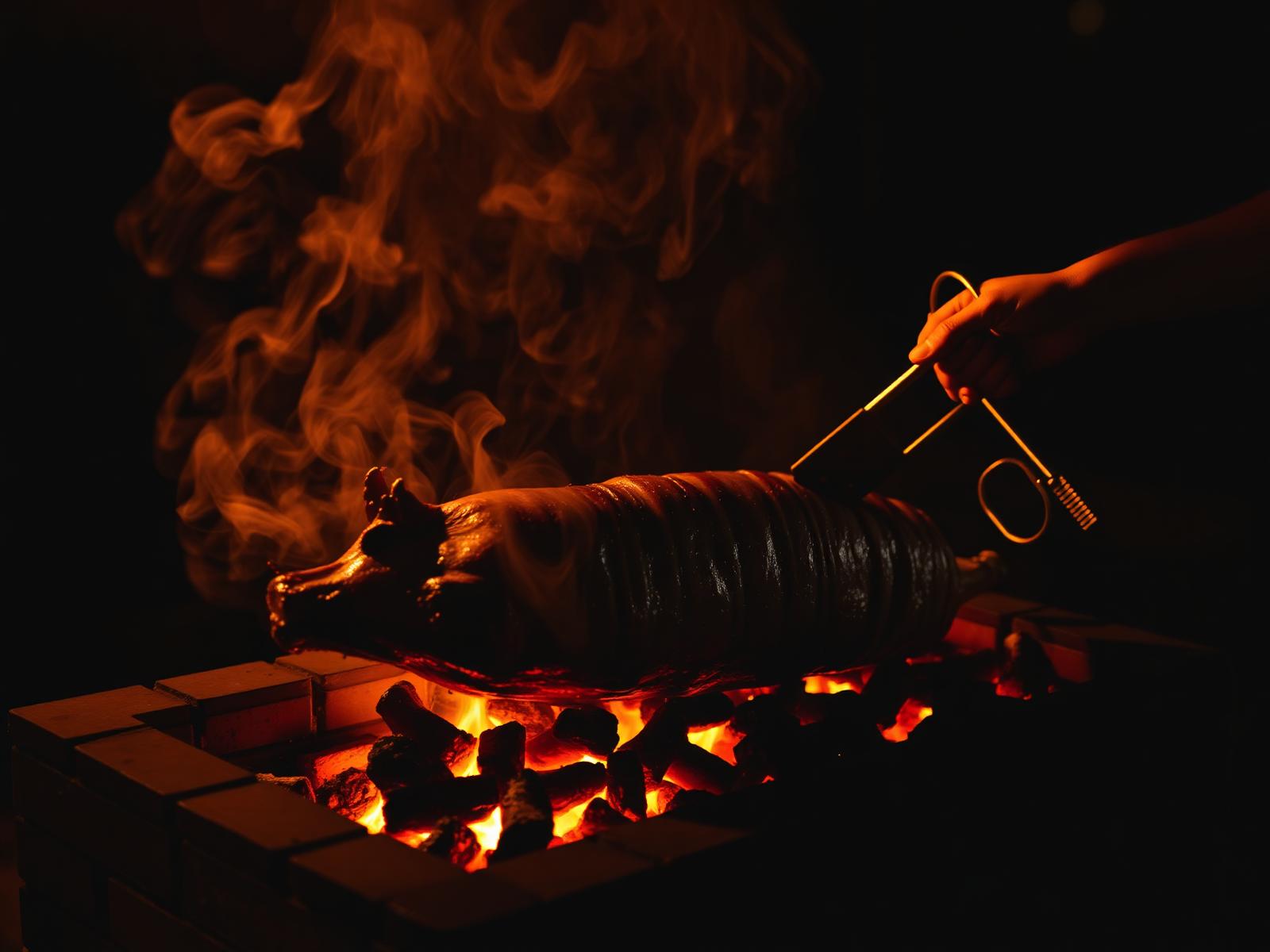
Smoke is the oldest technique in this canon, and it is the one that ties every region together. Before there were stoves, there was a pit in the ground, hardwood cut and burned down to coals, and meat laid over it low and slow until time did what heat alone could not.
What Europeans called 'barbecue' was a Taíno word carried through the Caribbean and then made into an art by African and Indigenous hands across the American South. The pit is the altar. The wood is the seasoning. The cook is the one who reads the fire.
Historical context
From the Lowcountry whole-hog tradition of Rodney Scott's people to the tomato-sauced Kansas City lineage, from Texas hot-link culture to the rib tips of the South Side of Chicago, smoke is the connective tissue. Adrian Miller's Black Smoke is the indispensable text on how the pit has been Black from the beginning.
Technical definition
Smoke is the controlled application of low, indirect heat and clean hardwood combustion gases to food over an extended period of time. Mechanically, hot smoke (225–275°F / 107–135°C) renders fat slowly, breaks down collagen into gelatin, and lays down a polymerized layer of phenols and aromatic compounds on the surface that we read as bark. Cold smoke (under 90°F / 32°C) deposits the same flavor compounds without cooking the food. The technique produces tenderness in cuts that resist any other method, a flavor that cannot be added afterward, and a preserved surface that extends shelf life.
How to execute it
- 01
Build a two-zone fire: direct coals on one side, nothing on the other. The food lives on the indirect side; the fire stays on the direct side. You are never 'grilling' barbecue.
- 02
Burn hardwood (oak, hickory, pecan, post oak) down to coals before it meets the meat. Raw flame gives acrid smoke; glowing coals give clean smoke.
- 03
Hold a steady temperature between 225–275°F (107–135°C) for most cuts; whole hog runs hotter in the shoulder end and cooler at the hams.
- 04
Season early and simply: salt and black pepper 12–24 hours ahead for large cuts. The smoke is the primary seasoning; everything else supports it.
- 05
Read the bark and the probe, not the clock. Brisket is done around 203°F (95°C) internal, when a probe slides in like warm butter. Whole hog is done when the shoulder pulls cleanly from the bone.
- 06
Rest the meat. Every hour in the pit wants 20–30 minutes of rest, loosely tented, so the juices redistribute.
Ratios, times, temperatures
- Salt: roughly 1.5–2% of the raw meat weight for large cuts (dry brine).
- Wood : protein: keep smoke 'thin blue,' not billowing white. More wood is not more flavor past a point.
- Time / weight: whole hog ≈ 1 hour per 10 lb at 250°F; brisket ≈ 1–1.25 hr per lb; ribs 4–6 hr total; pork shoulder 1.5 hr per lb.
Variations
- Wood is seasoning: oak is neutral and deep; hickory is strong and sweet-bitter; pecan is gentle; post oak is Texas brisket; fruit woods (apple, peach, cherry) are light and good on poultry and fish.
- Cold smoke: for cured fish, cheese, salt, butter, cornmeal, keep the chamber under 90°F (32°C).
- Smoked dairy and smoked produce: cold-smoked cream for cornbread; hot-smoked tomatoes for a Lowcountry gravy; smoked peaches for cobbler.
- Smoked seasoning meat: turkey wings, turkey necks, hog jowl, a whole secondary smoke lineage that feeds every pot of greens or beans in the South.
Common failure points
- ✕Too much smoke. 'Thin blue smoke' is a real phrase. If your pit is billowing white, the food will be bitter.
- ✕Peeking. Every time you open the lid you lose 15–20 minutes of cook time.
- ✕Cooking by clock instead of by probe. Meat is done when it is done, not when you wanted it to be.
- ✕Saucing too early. Sugar in sauce burns under 300°F; apply in the last 20–30 minutes only.
Canonical expressions
Eastern North Carolina whole-hog barbecue
Hardwood coals, vinegar-pepper finish, the entire animal cooked over a pit until the meat pulls and the skin shatters. Rodney Scott's Hemingway, SC lineage is the living textbook.
Central Texas brisket
Post oak, salt-and-pepper rub, the long sleep at 225°F until the point and the flat read 203°F. The Black pitmasters of the Texas Hill Country built this style before the Austin restaurants got the credit.
Memphis dry-rub ribs
Spareribs cooked over hickory with a paprika-and-cayenne rub, no sauce required, the smoke and the rub doing the work the sauce usually carries.
Kansas City burnt ends
The cubed point of a brisket returned to the smoker until the bark caramelizes around them; a Black Kansas City invention now treated as a national style.
South Side of Chicago rib tips and hot links
The riblet ends and house-made hot links smoked in glass-fronted aquarium pits — Lem's, Honey 1, the post-Migration Black urban barbecue lineage.
Smoked turkey wings and necks as seasoning meat
Not a dish on a plate but the smoke applied to the seasoning meat that flavors every pot of greens, beans, and field peas in the South.
Recipes from Black cooks & writers
- Rodney Scott's Whole Hog Method (Garden & Gun feature)
The living lineage of Lowcountry whole hog.
- Kevin Mitchell: The Black BBQ Tradition (Culinary Historians)
Historian-chef at Johnson & Wales Charleston.
- Bryant Terry: Smoked Collard Greens (Vegetable Kingdom)
Publisher page; buy the book for the recipe.
What else can this be?
Extensions
Smoke is not only for meat. Think about smoked dairy, smoked produce (peppers, tomatoes, stone fruit), smoked salts, smoked fats. What happens when you smoke pot likker before braising in it? What happens when you smoke cornmeal before making grits?
- →Cold-smoke heavy cream over pecan for two hours, then use it to make the custard for cornbread or for ice cream that pairs with peach cobbler.
- →Smoke stone-ground cornmeal cold for ninety minutes before milling it into grits, so the smoke is in the grain, not just the seasoning meat on top.
- →Run a batch of pot likker through the smoker (in a wide hotel pan, low and slow) before braising the next pot of greens in it. A smoked-pot-likker collards is its own dish.
- →Cold-smoke flake salt and finishing butter to use the way a French kitchen uses fleur de sel and beurre noisette — the seasoning, smoked first.
- →Hot-smoke whole stone fruit (peaches, plums, figs) for thirty minutes before they go into the cobbler or the preserves. The smoke survives the sugar and the bake.
Further reading
- Black Smoke, by Adrian Miller (Library)
- Soul Food: The Surprising Story of an American Cuisine, by Adrian Miller (Library)
- High on the Hog (Netflix), Library entry
- Black Smoke, by Adrian Miller
- Rodney Scott's World of BBQ
- High on the Hog (Netflix series)